Angular Admin Templates
Angular Templates Built for Enterprise-Scale Web Applications
1 Templates





Angular Templates Built for Enterprise-Scale Web Applications
Our Angular templates give development teams a production-ready starting point for building modern web applications. Instead of starting with an empty Angular project and building dashboards, tables, charts, and navigation systems one by one, teams begin with a working interface environment already in place.
Developers can connect APIs, integrate backend services, and start building application logic immediately. The dashboard layer, layouts, and core UI components are already well-designed.
This allows teams to move faster and focus on developing the product rather than assembling the interface infrastructure from scratch.
Built by Engineers Angular Experts Work
Angular remains one of the most powerful frameworks for building scalable applications. Enterprise systems, SaaS platforms, analytics tools, and internal management software frequently rely on Angular because of its strong architecture and predictable project structure.
Our engineering team works with Angular across multiple production environments. Over time, they noticed a repeated challenge. Every Angular project required the same operational interface layer.
- Data management panels.
- User administration.
- Reporting views.
- Authentication flows.
Our experts created Angular templates that already contain the essential UI architecture developers need to launch real applications.
A Strong Technical Foundation for Angular Applications
Our Angular Templates provide a ready-to-deploy interface environment that developers can immediately integrate with backend services and APIs.
Inside the template system, developers gain access to the components that usually require weeks of development work.
The framework includes:
- Multiple dashboard layouts designed for analytics and operational data
- Data tables capable of handling large datasets with filtering and sorting
- Interactive chart integrations for monitoring metrics and performance
- Form systems supporting validation and lean workflows
- Authentication pages including login and account access flows
- Application layouts designed for multi-page enterprise software
This foundation allows developers to begin implementing product functionality immediately rather than spending valuable engineering time assembling the interface infrastructure.
Angular Architecture Designed for Scalable Projects
Angular applications often power complex systems. For example, they are used for internal enterprise tools, SaaS control panels, financial dashboards and data management platforms.
Because of that, Angular interfaces must remain scalable and predictable as projects grow.
Our templates follow Angular’s architectural patterns so developers can extend the application naturally. Routing, module organization, and component relationships follow conventions Angular engineers already understand.
Developers opening the project can quickly locate where dashboards live, where UI components reside, and where new modules should be introduced.
That clarity matters when applications grow from small tools into full-scale platforms.
Designed for Data-Driven Interfaces
Angular applications frequently manage large volumes of operational data. Admin panels may need to display thousands of records, monitor system activity, or visualize business performance in real time.
Our Angular templates are designed specifically for these environments.
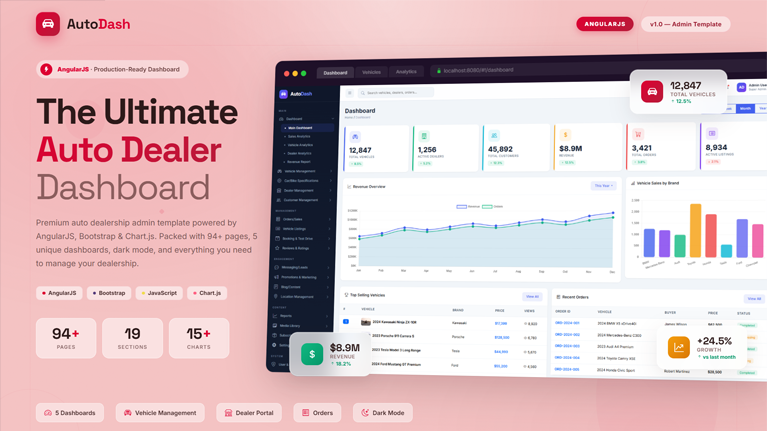
Dashboards present multiple KPIs in a single operational view. Charts display analytics trends clearly. Tables organize large datasets while keeping navigation fast and readable. Widgets show performance metrics without overwhelming the interface.
Even as datasets grow and additional modules appear, our templates remain usable.
Extend the Dashboard Without Rebuilding It
Many templates look fine until developers begin modifying them. But when you start adding new modules, they become sluggish. Expanding dashboards requires rewriting interface sections. Integrating APIs creates unexpected complexity.
But our Angular templates were built with real development workflows in mind.
Teams regularly introduce new analytics panels, operational widgets, configuration pages, or reporting systems as their product grows. These templates allow that expansion to happen smoothly.
Using our best Angular Templates, developers can introduce new features, connect backend services, and extend the interface without rebuilding the dashboard foundation.
Built for Real Angular Use Cases
Our Angular templates become especially valuable when applications require strong administrative interfaces.
You can use our full customizable Angular templates for:
- SaaS platform administration panels
- Enterprise operations dashboards
- CRM management systems
- Analytics and reporting platforms
- Internal company tools
- Data monitoring systems
Launch Angular Applications Faster
Every Angular project eventually reaches the same stage. The product requires an internal interface where teams manage users, monitor performance, and operate the system.
Building that interface from the ground up consumes valuable development cycles.
Our Angular Templates remove that delay.
Developers can start a scalable Angular environment that already includes dashboards, data interfaces, authentication flows, and operational UI components. Instead of building the same infrastructure repeatedly, engineering teams can move directly into product functionality.
For teams building Angular SaaS platforms, analytics tools, enterprise dashboards, or internal applications, that advantage shortens development timelines and helps projects reach production far faster.
So don’t wait, grab our Angular Templates right away and take the charge of your project!
Frequently Asked Questions
Common questions about Angular Admin Templates
What is an Angular template in web development?
What is an Angular admin template?
Why do developers use Angular templates?
What features are usually included in Angular templates?
Are Angular templates suitable for enterprise applications?
Can Angular templates be customized?
Do Angular templates include authentication pages?
Can your Angular templates manage large datasets?
Stay Updated
Subscribe to our newsletter and get notified about new templates, updates, and exclusive offers.
No spam, unsubscribe anytime.