


 Purchase Now
 Live Preview







 Purchase Now

Storely is the most complete premium ecommerce admin dashboard template available today, shipping with 190+ professionally designed pages, 18 fully-featured modules, and 100+ accessible UI components. Engineered for serious commerce teams, online store owners, multi-vendor marketplaces, and SaaS founders, Storely delivers a production-ready Next.js 14 admin panel with TypeScript strict mode, Tailwind CSS 3.4, Radix UI primitives, and Recharts visualizations — all wrapped in a unique, magazine-grade premium design system featuring a sophisticated indigo-violet brand palette with warm amber accents.
Complete Ecommerce Admin Dashboard with 190+ Pages
Unlike generic admin templates that ship with a handful of demo pages, Storely covers the entire lifecycle of a modern online store. Every screen is meticulously designed, every chart is real, every flow is wired, and every interaction provides instant feedback. From the first dashboard a store owner sees in the morning to the audit log their compliance team reviews every quarter, Storely has thought of everything.
Authentication and Onboarding Flow
Storely includes a complete authentication suite with seven dedicated auth pages: secure login with social providers (Google, Apple, magic link), full registration with country and currency selection, forgot-password flow with email reset link, password reset with strength meter, two-factor authentication with 6-digit OTP entry, beautiful lock screen with avatar, and a polished sign-out confirmation page. Every form is wired to navigate correctly with toast feedback.
Real-time Dashboard and Analytics
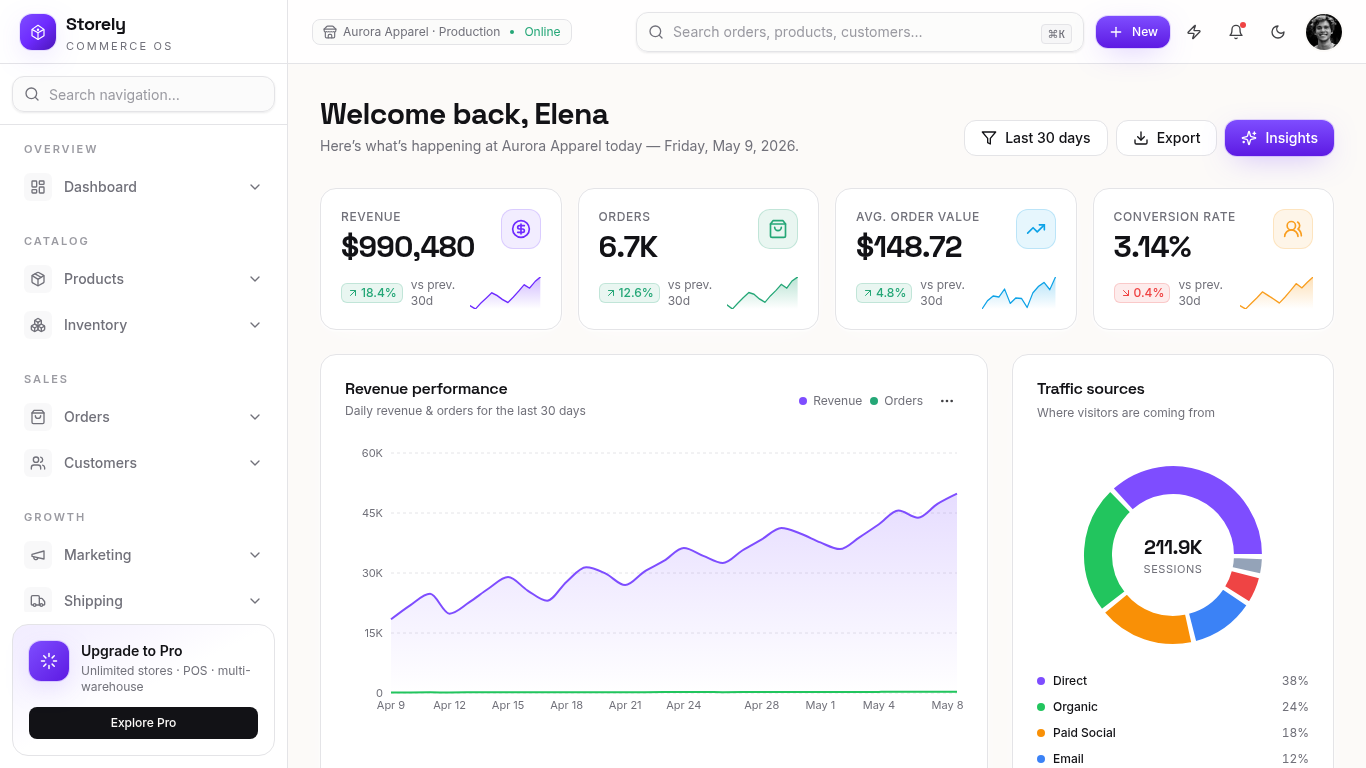
The Storely dashboard module delivers four distinct analytical views: a main dashboard showing revenue, orders, average order value, and conversion rate with sparkline trends; a deep analytics dashboard featuring conversion funnels, cohort retention heatmaps, and device-source breakdowns; a sales overview with hourly heatmaps and channel mix; and a real-time activity stream that simulates live visitors, carts in progress, and instant pageviews with pulsing animations.
Advanced Product Catalog Management
The products module ships with 15 fully-realized pages for catalog management. The product list offers both grid and table views with image-rich cards, status filters, search, and bulk selection. Add and edit forms include media galleries, rich-text descriptions with AI-assist callouts, pricing with cost-of-goods and margin calculation, inventory tracking, SEO meta with live search-result preview, and visibility toggles per channel. Variants, categories, sub-categories, brands, tags, attributes, attribute sets, product reviews, import/export with smart column matching, bulk price editing, and trash/archive recovery are all included.
Multi-Warehouse Inventory System
Storely’s inventory module handles complex stock operations across multiple warehouses. The stock list shows live quantities by SKU and warehouse with health indicators and days-of-cover calculations. Stock adjustments capture every movement with reason codes and operator attribution. Low-stock alerts and out-of-stock pages surface action items with restock buttons and lost-revenue calculations. Warehouses page presents fulfillment locations as photo cards with capacity utilization. Stock transfers track inter-warehouse movement, complete history provides an audit-grade timeline, and the barcode/SKU manager generates printable EAN-13 barcodes.
Complete Order Management Pipeline
The orders module is the most comprehensive in any ecommerce admin template, with 16 dedicated pages. Beyond the all-orders list, status-specific pages cover pending, processing, shipped, delivered, cancelled, returned, and refunded orders, each with bespoke KPIs and action queues. The order details page is a tour-de-force: line items, pricing breakdown, full fulfillment timeline with color-coded states, customer card, shipping and payment info, plus print-ready invoice, packing slip, and shipping label pages. Manual order creation, live shipment tracking with carrier integration, abandoned cart recovery, and draft orders complete the suite.
Customer Relationship Management
Storely’s customer module provides nine pages for understanding and serving shoppers. The customer list displays country flags, lifetime value, group, and order history. The customer details page features a hero header with VIP badge, spending pattern chart, and tabbed sections for orders, addresses, wishlist, reviews, and internal notes. Customer groups define VIP, returning, new, and wholesale tiers with auto-assignment thresholds. Address book, wishlist conversion reports, banned customer management, and guest customer reactivation are all built in.
Marketing Automation and Campaigns
Fourteen marketing pages cover every promotional surface: coupons and discount codes with usage tracking, time-bound flash sales with countdowns and progress bars, cart rules engine with conditional logic, catalog rules for site-wide pricing, four-tier loyalty program with point earn rules, gift cards with branded card design, customer referrals with conversion attribution, full affiliate program with tier-based commissions, newsletter subscriber management, email campaign builder, SMS campaigns, push notifications, popup and banner manager, and abandoned-cart recovery flows with multi-step automations.
Shipping, Fulfillment, and Logistics
The shipping module organizes zones, methods, rates, and carriers across eight pages. Define shipping zones grouping countries together. Configure methods (standard, express, free, priority, in-store pickup) with pricing rules. Set per-zone rates by weight or subtotal. Connect carriers like DHL, FedEx, UPS, USPS, PostNord. Group products into shipping classes with surcharges. Manage pickup locations as photo cards. Visualize delivery slot capacity with a 7-day heatmap. Track active shipments with live carrier status.
Payments, Tax, and Currency
The payments module spans ten pages of financial operations. Enable payment methods (Visa, Mastercard, Apple Pay, Google Pay, PayPal, Klarna, Affirm). Connect gateways (Stripe, PayPal, Adyen, Braintree). Browse the transactions ledger with charges, fees, and net settlement. Issue refunds. View payouts to your bank. Manage tax rules per jurisdiction, tax classes per product type, and tax zones grouping regions. Multi-currency support with primary currency, exchange rates, and ECB-style live FX charts.
Reports and Business Intelligence
Fourteen reporting pages provide deep insight: sales reports with channel breakdown, revenue (MTD/QTD/YTD with EOY forecast), product performance with margin and trend, top selling, customer acquisition and LTV, order pipeline, tax collection by jurisdiction, coupon usage with discount cost vs revenue lift, stock by category, full P&L statement, refund reasons analysis, traffic and conversion funnel, cart abandonment with recovery attribution, and a custom report builder with drag-and-drop dimensions and metrics.
Content Management System and Storefront
Storely includes a full CMS with thirteen pages for publishing: static pages with WYSIWYG-ready editor, blog posts in card layout, blog categories, comment moderation, header and footer menus with drag-handle sortable items, hero sliders and announcement banners, full media library with folder organization and grid view, FAQ manager with helpful-vote tracking, testimonials, and template editors for transactional email, SMS, and notification messages.
Multi-Vendor Marketplace Module
For multi-vendor commerce, Storely ships nine vendor pages: vendor list with photo hero cards, vendor detail with cover image, KPIs, products, orders, and payouts tabs, approval queue for new vendor applications, vendor product catalog, vendor order pipeline, weekly payout settlements, tiered commission structure, vendor reviews with rating distribution, and marketplace-wide vendor settings.
Reviews, Q&A, and Reputation Management
Storely’s review system includes six pages: all reviews with star distribution, pending approval queue with approve/reject/spam actions, approved reviews live on the storefront, rejected reviews with reason logs, automated spam detection, and a Q&A manager where merchants answer customer questions on product pages.
Customer Support and Help Desk
The support module covers six pages: ticket queue with priority and SLA, full conversation view with right-rail customer context and SLA timers, ticket categories for routing, real-time live chat interface with conversation list and message bubbles, contact form messages, and a structured knowledge base.
Staff, Roles, and Permissions
Five staff pages provide enterprise-grade access control: user list with role and online status, add/edit user with security toggles (require 2FA, SSO only, IP allowlist), roles and permissions matrix with granular CRUD checkboxes per resource, activity log with full audit trail, and login history with device, IP, location, and success/blocked status.
System Settings and Configuration
Storely’s settings cover twenty configuration pages — by far the deepest of any admin template: general store info with tax IDs, localization with multi-language and format preferences, branding with logo variants and brand color picker, email SMTP with DNS verification (SPF/DKIM/DMARC), SMS gateway (Twilio), social login providers, social media handles, SEO defaults with search-snippet preview, sitemap generation, robots.txt editor, cookie consent categories, GDPR data subject requests, API keys with scope management, webhooks with health monitoring, integrations marketplace, backup and restore, cache management, maintenance mode, system info dashboard, and update manager.
Premium Profile Page with Magazine-Style Design
The Storely profile page is a showcase: cinematic cover hero with parallax-feeling gradient, oversized verified avatar, identity strip with pronouns and timezone, four KPI cards with sparklines, structured about section with languages and specialties, today’s agenda timeline with live “now” pulse, GitHub-style working-pattern heatmap, Q3 personal goals progress bars, milestone awards with gradient icons, recent activity feed, inbox snapshot, direct reports with presence dots, press quotes with watermark glyphs, connected OAuth accounts, and active session list with revoke buttons.
Utility, Error Pages, and Empty States
Nine utility pages cover everything else: branded 404, 403, 500, and 503 error pages with gradient typography, coming-soon page with countdown and email capture, library of polished empty states, search results page across resources, notifications center with read/unread states, and append-only audit log with SOC 2 compliance badge.
Advanced Modules — POS, Subscriptions, B2B, Multi-store
Eleven advanced modules unlock specialized commerce: a fully working point-of-sale register with searchable product grid, tap-to-add cart, quantity steppers, tax calculation, and charge button; subscription management with MRR and churn metrics; bookings and appointments calendar; auctions with reserve prices and bid counters; digital downloads with DRM and license tracking; pre-orders with deposit collection; product bundles with discount stacking; B2B request-for-quote workflow; wholesale pricing tiers (Tier 1 through Tier 4); multi-store management for multiple storefronts on one backend; and multi-language manager with translation completeness tracking across 38 languages.
Modern Tech Stack and Engineering Quality
Storely is built on the most modern, opinionated, and maintainable stack available: Next.js 14 with the App Router, TypeScript 5.6 in strict mode, Tailwind CSS 3.4 with custom design tokens, Radix UI primitives for accessibility, Recharts 2.13 for responsive data visualization, Lucide React icons, Sonner for toast notifications, Framer Motion for animations, Inter and Space Grotesk for typography, and next-themes for light and dark mode persistence.
Light Mode and Dark Mode Themes
Storely ships with first-class light and dark mode support. The theme system uses HSL CSS variables wired through Tailwind, with carefully tuned values for both palettes. The light mode uses a warm off-white background for reduced eye strain. The dark mode uses a deep navy with violet undertones — never a flat gray. Theme preference is persisted to localStorage and respects the system prefers-color-scheme setting.
Mobile Responsive and Mobile-First Drawer Navigation
Every page in Storely is fully responsive. On desktop, a 288-pixel sidebar holds the full navigation tree. On mobile, the sidebar is replaced by a hamburger menu in the topbar that opens a slide-in drawer using Radix Dialog. The drawer auto-closes on route change and the navigation hierarchy is identical between desktop and mobile.
Real Charts, Real Data, Real Images
Unlike templates that ship placeholder data, Storely uses realistic, deterministic mock data for products, customers, orders, vendors, sessions, and analytics. Product images are fetched from Unsplash. Country flags from FlagCDN. User avatars from Pravatar. The 30-day sales series, traffic mix, top countries, cohort retention, and live activity data are all hand-crafted to look like real Aurora Apparel store data, making demos and stakeholder reviews indistinguishable from production.
Built-in Demo Interaction Layer
A unique feature of Storely is the global demo interaction layer: every button click that doesn’t have an explicit handler shows a contextual toast notification with the button label, every form submission preventDefaults and shows a “Saved ✓” toast with a “Demo mode — wire to your API” hint, and Radix-managed primitives (dropdowns, switches, tabs, dialog close) are auto-detected and excluded so they continue to work as designed. This means the entire 190-page template feels fully interactive out of the box without any custom wiring.
Production-Ready Code Architecture
Storely’s source code is organized for production: routes use Next.js App Router groups ((auth) and (dashboard)) for shared layouts; UI primitives live in src/components/ui; layout components in src/components/layout; data widgets in src/components/data; charts in src/components/charts; navigation config in src/config/nav.ts as the single source of truth for both desktop sidebar and mobile drawer; mock data in src/lib/data/mock.ts ready to be swapped for API fetch; and utility helpers in src/lib/utils.ts.
Who Storely Is For
Storely is the ideal premium admin template for: ecommerce founders launching a Shopify or WooCommerce alternative; SaaS startups building a merchant dashboard; agencies delivering admin panels for client stores; multi-vendor marketplace operators; B2B wholesale platforms; subscription commerce businesses; in-house engineering teams replacing legacy admin tools; and designers who want to ship a beautiful admin without building from scratch.
What You Get with Storely
Every Storely licence includes the full Next.js 14 source code, all 190+ pages, light and dark mode themes, 12+ chart types, the complete component library, mock data fixtures, mobile responsive design, the demo interaction layer, lifetime updates (Studio and Agency tiers), Figma source files (Studio and Agency), white-label rights (Agency), and a 30-day money-back refund policy.
Get Started with Storely Today
Storely is shipped as a production-ready Next.js 14 application. Clone the repository, run npm install, run npm run dev, and the entire 190-page admin is running at http://localhost:3000 in under 60 seconds. No backend is required to demo the template — the realistic mock data layer means every page renders fully on first load. When you’re ready to wire it to your real API, the data layer is one file (src/lib/data/mock.ts) and replacing it is a straight find-and-replace.







 Live Preview