ReactDash – Premium Admin Dashboard & SaaS Template

HTML5 CSS3 JavaScript jQuery Tailwind CSS
Need Help ?
ReactDash – Premium Admin Dashboard & SaaS Template - Premium Template

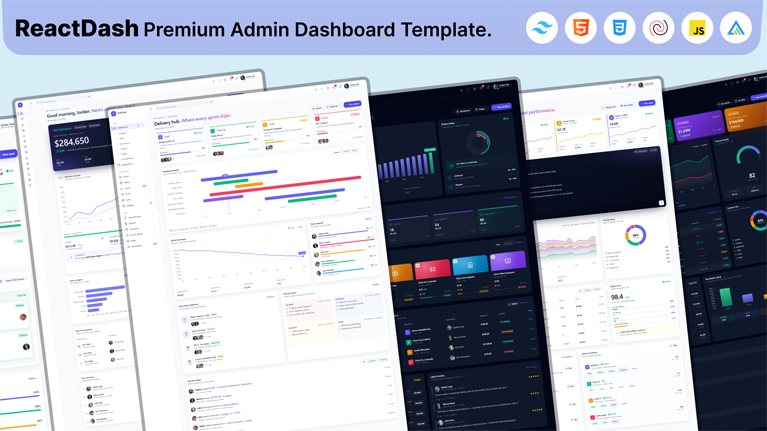
ReactDash is a premium admin dashboard template with 6 unique dashboards (Analytics, CRM, E-commerce, Finance, Project, AI), 7 working applications, 40+ inner pages and 300+ components. Built with Tailwind CSS v4 and jQuery, hand-tuned dark mode, three chart libraries and lifetime updates.

6+

Inner Pages

100%

Fully Responsive

Clear Documentation

Premium Support

Regular Updates

Need Help? We're Here For You

Our dedicated support team is available 24/7 to help you with any questions or issues. Get in touch with us anytime.

24/7

Availability

Fast Response

Time

Expert

Assistance

Versatile Dashboard Options

Discover our most popular modern, responsive, and developer-friendly admin dashboard templates.

Every industry has a dashboard here.

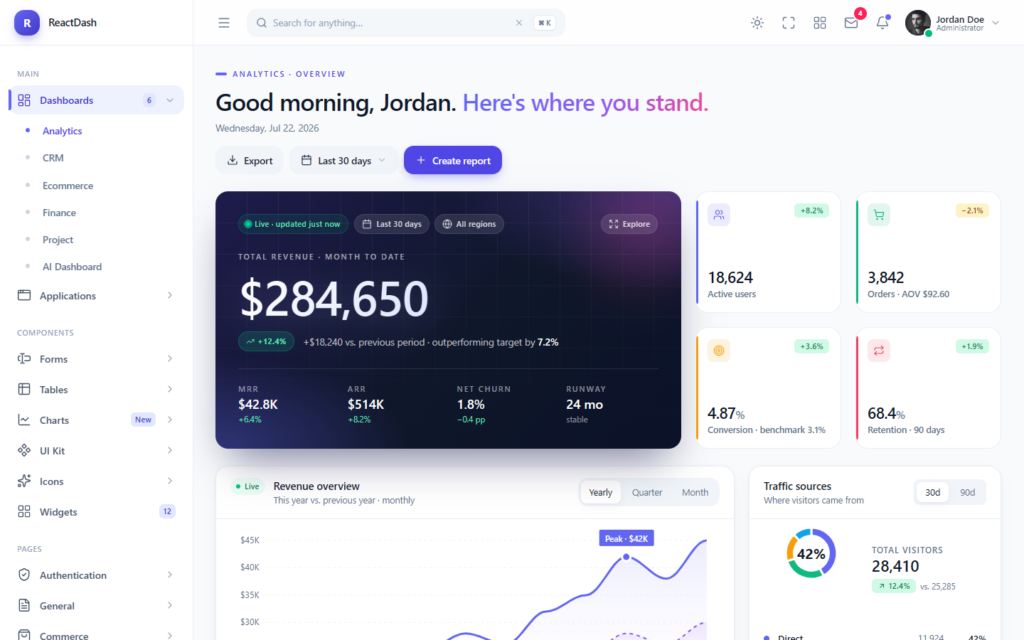
Analytics · Overview

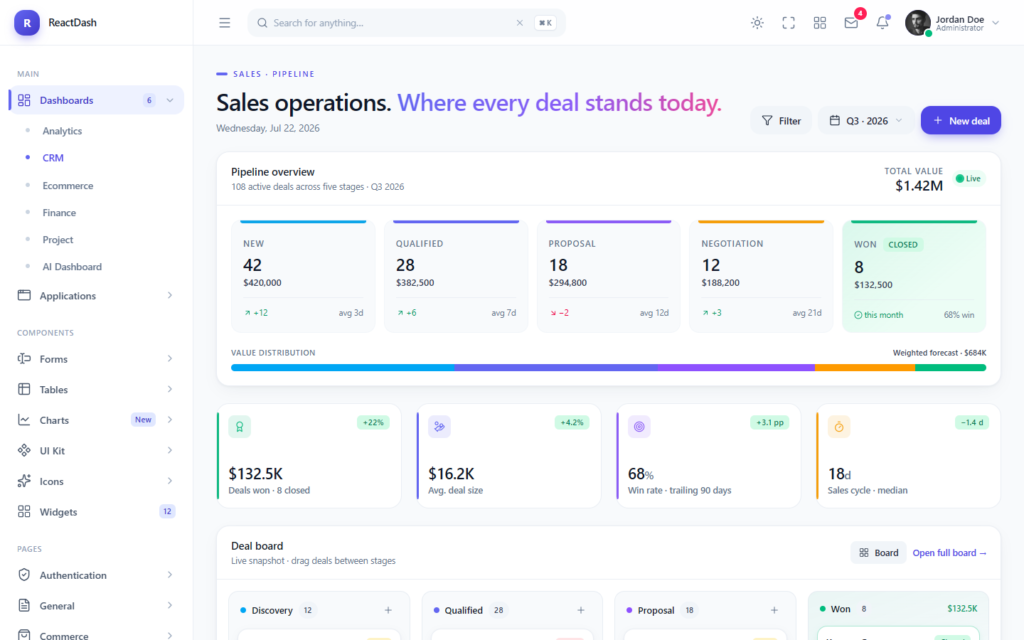
CRM · Pipeline

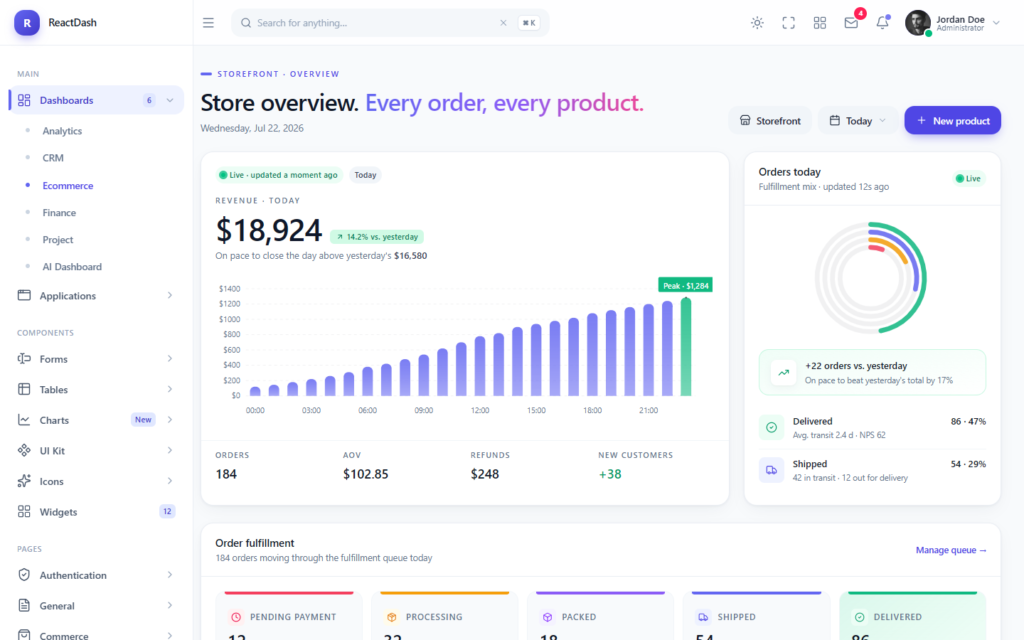
E-commerce · Storefront

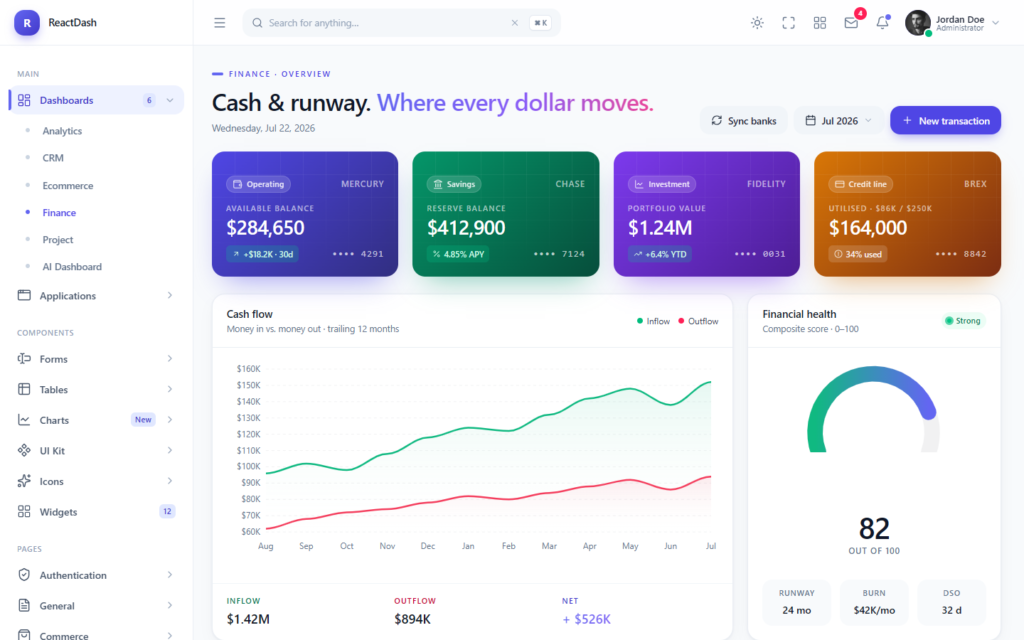
Finance · Wallets

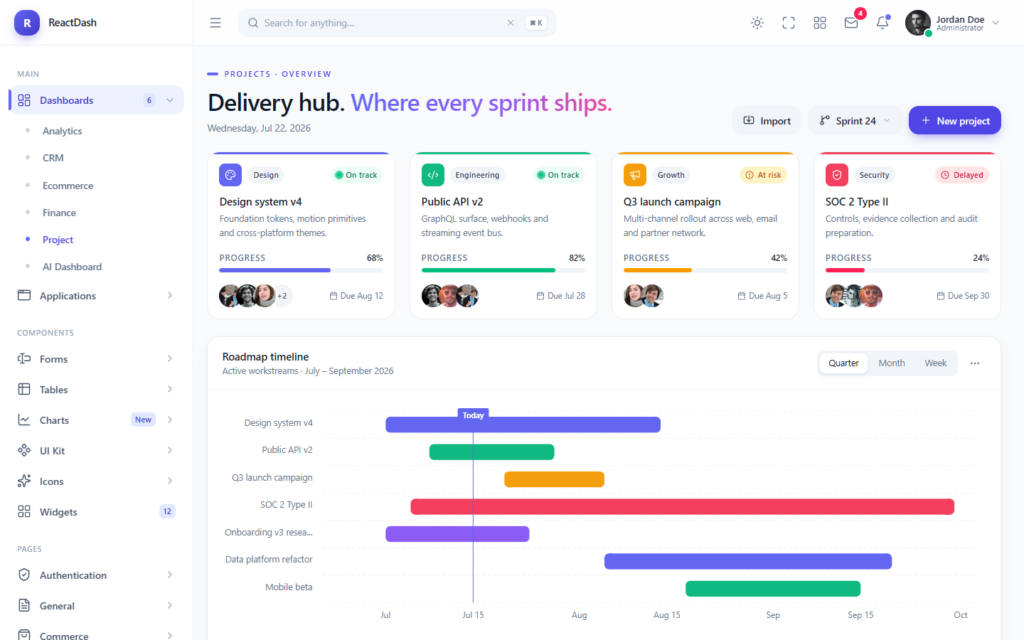
Project · Delivery

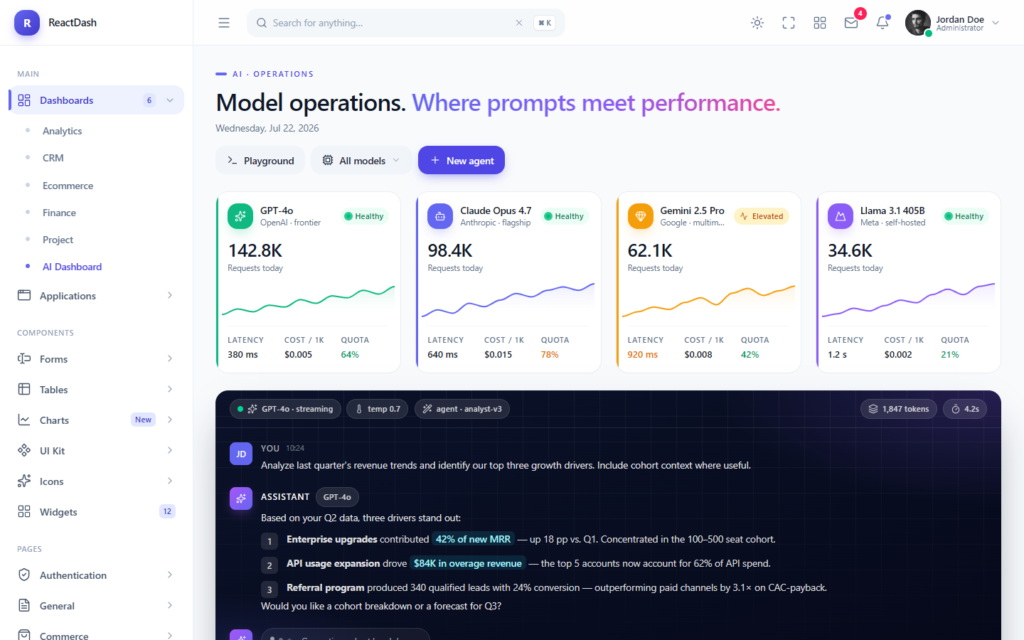
AI · Operations

Flexible pricing plans tailored for your business

Discover our range of professionally designed templates.

100% Moneyback Guarantee
Secure Checkout · Instant Download · Risk Free

Single Use

Use in one end product that end users are not charged to access — one project, one developer.

$24
Purchase Now
  • Full source code
  • Documentation
  • Use in SaaS app
  • Projects 1

Multiple Use

Use across up to three end products with no user fees. Ideal for freelancers and small studios.

$49
Purchase Now
  • Full source code
  • Documentation
  • Use in SaaS app
  • Projects 3

Extended Use

Use in unlimited end products with no user charges — built for agencies shipping many client sites.

$199
Purchase Now
  • Full source code
  • Documentation
  • Use in SaaS app
  • Projects Unlimited

For Business

Use in unlimited products your end users can pay for, including SaaS and paid apps.

$299
Purchase Now
  • Full source code
  • Documentation
  • Use in SaaS app
  • Projects Unlimited

ReactDash is a premium admin dashboard template built for real product teams that need to ship a polished web application in days rather than months. Powered by Tailwind CSS v4, jQuery 3.7 and Lucide Icons, it delivers a modern, lightweight foundation that works with any backend — Rails, Django, Laravel, .NET, Node.js or a static site generator. Every page is hand-crafted with production-ready markup, sensible defaults and a design system that scales from a solo indie build to a full enterprise product.

Six Unique Dashboards

ReactDash ships with six distinct dashboards, each designed as a first-class product rather than a colour swap. The Analytics dashboard focuses on high-level KPIs with a bento-style hero, revenue chart, traffic sources, orders and geographic distribution. The CRM dashboard turns the surface into a sales command centre with pipeline kanban, win-rate funnel, sales-rep leaderboard and MRR / ARR trending. The E-commerce dashboard is oriented around store operations — revenue waterfall, category performance, top SKUs, live orders and inventory alerts. The Finance dashboard is a personal-money view with balance cards, spending category donuts, cash-flow charts, transactions and cards. The Project Management dashboard focuses on delivery — sprint burn-down, task board, team capacity, velocity and release calendar. The AI Operations dashboard is a control room for LLM-based products — model comparison, token spend, latency heatmap, prompt library and a working Copilot console.

Seven Working Applications

Beyond the dashboards, ReactDash includes seven full application screens with realistic interactions. The Email application is a three-pane inbox with folders, labels, search and a rich reader. The Chat application implements threads, reactions, typing indicators and attachments. The Calendar application supports month, week and day views with colour-coded events. The Kanban board provides drag-and-drop cards, avatars, tags and card counts per column. The Contacts application is a searchable contact-card grid with tags and a detail panel. The File Manager offers grid and list views, storage gauge, quick upload and sharing. The AI Assistant is a full chat interface with conversation history, inline data cards, source connections and prompt suggestions.

Forty-Plus Inner Pages

ReactDash covers every screen a real product needs. The Authentication set includes login, register, forgot password, reset password, email verification, two-factor authentication and lock screen — all with a split-screen dark-gradient hero on the wider auth pages and a clean centred card on the simpler ones. The General pages cover Profile with contribution heatmap and career timeline, Settings with tabbed preferences, Pricing with three-tier plans and a feature-comparison matrix, FAQ with grouped accordions, Team with a searchable contact-card grid, a full Timeline page, Gallery with a working image lightbox, Search results and a Blank page starter. The Commerce pages include Invoice list, Invoice details with printable layout, Order details with a five-step fulfilment timeline, User list with photo avatars and User details with a profile cover, KPIs and 12-month spend chart. The Error and System pages include 404, 500, Coming Soon with a countdown, and Maintenance — all rendered chromeless without sidebar or topbar. Standalone pages include Maps with an animated SVG world map and the AI Assistant.

Three Hundred Plus Components

ReactDash includes over three hundred handcrafted UI components across cards, tables, forms, dropdowns, modals, tabs, accordions, timelines, avatars, badges, chips, alerts, buttons, progress bars, tooltips, off-canvas panels and typography. Form patterns include layouts, elements, validation, file upload, rich editors and multi-step wizards. Table patterns include basic, editable, responsive, grid and data-table with search and sort. The widgets library adds countdowns, weather cards, activity heatmaps, contribution grids, gauges, image lightbox and OTP inputs.

Three Charting Libraries Bundled

ReactDash bundles three of the most popular charting libraries — ApexCharts, Chart.js and Apache ECharts — themed to match the dashboard palette. Sparklines, gauges, heatmaps and a chart-timeline pattern are provided out of the box. Every chart adapts its colour tokens to light or dark mode automatically, and the samples across dashboards show best-practice patterns for bar, line, area, donut, radial, mixed, stacked and comparison charts.

Four Icon Libraries

The template ships with four icon libraries. Lucide is the default with over one thousand outline icons used across every dashboard and application. Remix Icons provides an alternative outline style. Bootstrap Icons cover a familiar Bootstrap-aesthetic. Font Awesome is included for teams already invested in it. Any icon library can be swapped by class without touching the markup structure.

Hand-Tuned Dark Mode

Every page in ReactDash ships with a dark variant that was tuned by hand rather than auto-inverted. Contrast, colour and shadow were all picked for the dark palette. The theme toggle is stored per user in localStorage, respects the operating-system preference on first visit, and applies the correct theme before body render to eliminate flash of unstyled content. The Tailwind v4 CSS-first token layer makes it trivial to add additional themes or brand palettes.

Tailwind CSS v4 CSS-First Architecture

ReactDash uses the new Tailwind CSS v4 CSS-first architecture with the @theme directive for design tokens. There is no PostCSS configuration to maintain — one config file, one npm command, and the build completes in under four seconds cold. The @custom-variant directive powers dark-mode class toggling, and every token is exposed as a CSS custom property that can be overridden per project or per section. The output CSS is minified and averages well under one hundred kilobytes even with every dashboard and page included.

Modern JavaScript, No Plugin Bloat

The interactive layer is written in one small, modular jQuery 3.7 file organised into named modules — Theme, Sidebar, Dropdown, Charts, Apps, Forms, Tables, ChartsPages, UIKit, Widgets and Pages. There is no jQuery UI, no legacy plugin sprawl and no build framework lock-in. Alpine.js is included as an optional deferred script for teams that prefer declarative behaviour on top of the jQuery baseline. The whole surface works without a build framework — drop the compiled CSS and JS into any backend template engine.

Production-Ready and Extensible

Every page is standalone HTML that renders correctly under file://, over a local server or behind any production backend. There are no inline styles, no inline scripts and no inline event handlers — everything routes through the shared CSS and app.js. The template ships with a favicon in SVG, semantic meta tags for Open Graph and Twitter Card, Inter and JetBrains Mono as variable fonts, an OTP input helper, an image lightbox with keyboard navigation and an AI chat auto-scroll. One purchase includes lifetime updates and six to twelve months of email support depending on the license tier.


Why Developers Choose Us

Our templates include everything you need to create modern, scalable websites with ease.

Responsive Design

Every template is fully responsive and looks stunning on all devices - from mobile to desktop.

Lightning Fast

Optimized for performance with minimal CSS and no dependencies. Your site will load in milliseconds.

Easy Customization

Easily customize layouts, colors, typography, and components to match your brand identity.

Clean Code

Well-organized, commented code that's easy to understand and modify for your needs.

Regular Updates

Get free lifetime updates with new features, improvements, and security patches.

Premium Support

Get help when you need it with our dedicated support team available 24/7.

Frequently Asked Questions

Find answers to the most common questions about orders, shipping, returns, and more.

Still have a question?

We're here to help! Reach out to our support team and we'll get back to you as soon as possible.

What is an admin dashboard template and how is it used in web applications?
An admin dashboard template is the control room of a web application. Every serious product has one. It is where administrators manage users, teams monitor activity, and product managers watch performance numbers move in real time. Instead of designing and building this interface from scratch, developers start with a template that already contains the structural UI layer required for operations. Inside it live dashboards, reporting panels, tables that hold thousands of records, configuration pages, and system controls. Engineers connect their backend services to this interface and immediately gain a working operational console. That shortcut removes a large portion of repetitive interface development that most web applications eventually require.
Which frameworks do modern admin dashboard templates usually support?
Admin dashboards rarely exist in isolation. They must fit directly into the development stack already running the product. For that reason most modern dashboard templates support several popular front-end frameworks. React appears most often because its component system fits data-heavy interfaces extremely well. Next.js commonly follows when teams want server rendering and efficient routing. Angular remains common inside enterprise environments where applications grow large and structured. Vue attracts teams who prefer lightweight reactive frameworks. Bootstrap dashboards remain useful for rapid interface deployment, while Tailwind dashboards provide extremely flexible styling systems. Supporting these frameworks allows teams to integrate dashboards into existing projects without reworking their entire codebase.
What features should a high-quality admin dashboard template include?
A capable admin dashboard template operates like the operating system of the application’s internal environment. It brings together multiple UI elements that administrators rely on constantly. Analytics dashboards visualize performance data through charts and graphs. Large data tables allow teams to browse and manage records such as users, transactions, or inventory items. Forms enable structured workflows like product creation or account management. Authentication pages handle system access. Notification panels show system events. Reporting modules summarize trends. Navigation systems tie everything together so users can move quickly between operational areas. When those components already exist, development teams skip weeks of repetitive interface work.
How much development time can an admin dashboard template save?
Admin dashboard templates compress the entire development phase dramatically. The UI infrastructure already exists. Developers move straight into connecting APIs, integrating databases, and wiring business logic into the interface. A dashboard template removes weeks of front-end engineering work and allows product features to reach production much faster.
Are admin dashboard templates suitable for large SaaS platforms?
Yes, and many SaaS products actually begin that way. The administrative needs of SaaS platforms tend to follow familiar patterns. Teams need user management panels, analytics views, subscription data, reporting tools, configuration pages, and system monitoring dashboards. A strong dashboard template already contains the UI structure required for these operations. Developers then extend it by adding application-specific data layers and new modules as the product evolves. Startups benefit because they launch quickly with a polished operational interface. In short, admin dashboard templates are very well suited for large SaaS platforms.
Can developers customize admin dashboard templates easily?
Yes of course! In fact, customization is a major reason teams choose dashboard templates in the first place. No two applications display identical data or follow identical workflows. Therefore, developers usually use dashboards extensively once the template enters a project. This makes sure that entire modules such as billing systems, order management panels, or customer support tools often get introduced. Templates are useful because they can change the branding easily. Because dashboard templates rely on reusable UI components, developers extend the interface gradually without rewriting the foundation.
Which types of applications commonly use admin dashboard templates?
Admin dashboards appear almost everywhere modern software operates. SaaS platforms depend on them to manage users and monitor product performance. Ecommerce companies operate inventory systems, orders, and sales metrics through dashboards. CRM tools use dashboard panels to organize customer records and communication history. Even analytics platforms use them to visualize reporting data.  Some enterprise tools depend on dashboards to track operations and system activity. Some marketplaces and fintech applications also depend heavily on administrative interfaces.

News & Articles

Discover our most popular modern, responsive, and developer-friendly admin dashboard templates.

Subscribe to our newsletter

From strategy to execution, we help you create powerful digital experiences that drive real results.

Stay Updated No spam, unsubscribe anytime.